Best Value LLM Subscriptions in 2026: Picks by Price Tier ($200, $100, $20, Under $20)
 Dmytro Chaban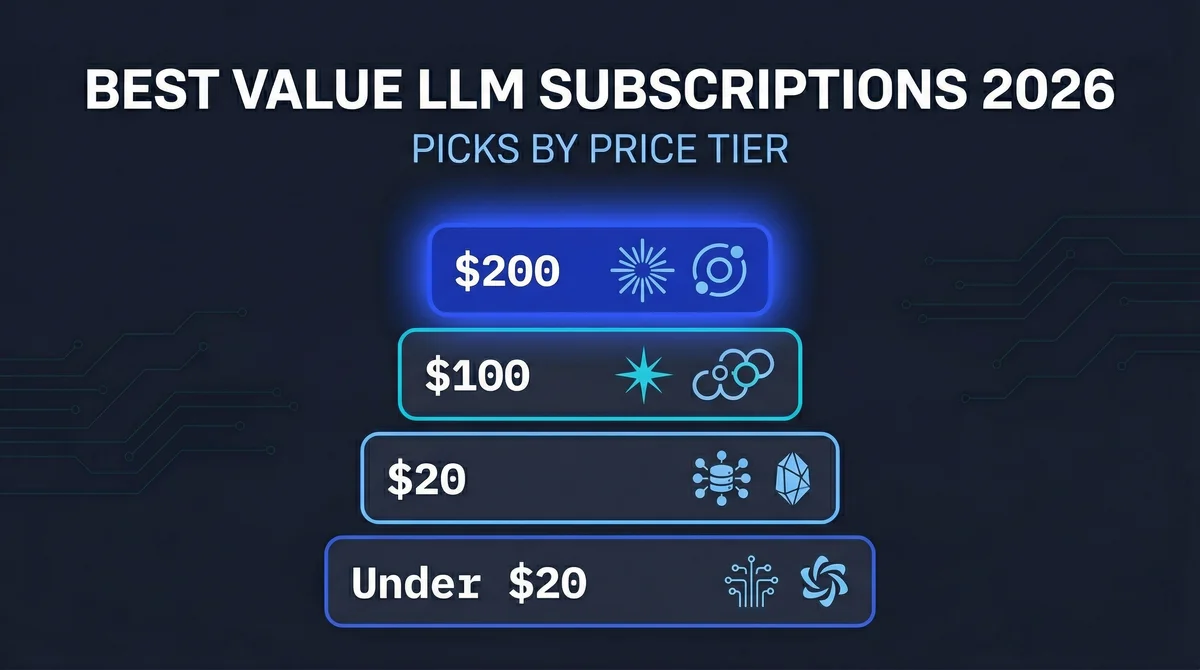
Most "best AI subscription" articles are the same alphabetized vendor list written by someone who clearly doesn't pay for any of them. I'm currently running Claude Max for all of my day-to-day coding work, and I've paid for and tested most of the rest at some point over the past year. This post is organized the way the decision actually happens: by what you're willing to spend per month.
TL;DR: Winner per tier#
| Price tier | Winner | Runner-up / Alternative | Who it's for |
|---|---|---|---|
| $200/mo | Claude Max 20x | ChatGPT Pro 20x | Frontier power users who live in Opus 4.6 and Claude Code |
| $100/mo | Claude Max 5x | ChatGPT Pro 5x / Synthetic.new (~$80) | Serious developers who want pro limits without doubling the bill |
| $20/mo | ChatGPT Plus | Gemini Pro + Antigravity bundle | Daily drivers who need one sub to cover everything |
| Under $20 | Google AI Plus ($7.99) | ChatGPT Go ($8) / NanoGPT | Budget chat access, not dev work |
Bottom line: if you can afford one sub and you code for a living, spend the $200 on Claude Max 20x and stop reading. Everyone else: keep going. The $100 and $20 tiers are where the interesting trade-offs live.
Key takeaways#
- Claude Max 20x is the best $200 sub for coders. Opus 4.6 + Claude Code is unmatched for daily coding work.
- Claude Pro at $20 is a trap. You get locked out of Opus after ~30 minutes. ChatGPT Plus is the honest $20 pick.
- The OpenCode-friendly subscription market exists. Synthetic.new, Kimi K2.5 Pro, and NanoGPT are real options mainstream roundups skip.
- Pay monthly on everything. Models drop monthly in 2026. Don't lock in for a year.
How I picked#
Two axes: price tier ($200, $100, $20, or less) and use case (agentic coding, long-context analysis, planning). I only included subs I've used in production, cross-checked against our LLM pricing tracker. Pricing snapshot: April 2026.
If you want per-token API pricing instead of flat-rate monthly, start with my best budget coding LLMs guide.
The $200 tier: frontier power users#
The $200 bracket is where the two real players live: Claude Max 20x and ChatGPT Pro 20x. Google AI Ultra ($249.99) exists for image/video workflows but isn't a coding sub (see the master table for specs).
Winner: Claude Max 20x at $200/month#
What you get: 20x the Opus usage of Claude Pro, unmetered Claude Sonnet 4.6, and Claude Code access with generous agent limits. Enough headroom to run Claude Code as your daily driver without hitting walls mid-session.
Claude Opus 4.6 is, as of April 2026, the best all-around model for coding, agentic work, long-document analysis, and writing that needs real tone sensitivity. I covered why Opus pulls ahead of Gemini and Codex in my Opus 4.6 vs Codex 5.3 comparison. Short version: it's the best Aider-leaderboard model I've tested, the best Claude Code backend, and the best long-context reasoner for agentic work.
The ceiling is high. I've put entire monorepos through the Opus 4.6 1M-context window without hitting a meaningful wall. For production-grade refactors, architectural reviews, or multi-turn agentic work, this is the most capable day-to-day sub I've used.
Skip Claude Max 20x if: you don't use Claude Code, you do most of your reasoning work in a chat interface (ChatGPT Pro's GPT-5.4 Pro is better for pure-chat reasoning), or you genuinely don't hit Opus limits on Claude Pro.
Runner-up: ChatGPT Pro 20x at $200/month#
OpenAI just restructured ChatGPT Pro to mirror Claude Max's 5x/20x tiering. The 20x tier sits at $200/month (the 5x tier lands at $100, covered below in the $100 bracket).
What you get: 20x usage of GPT-5.4 Pro (OpenAI's strongest reasoning model, announced April 2026), maximum Codex tasks, unlimited GPT-5.3 and file uploads, unlimited and faster image creation, maximum deep research and agent mode, and research preview of new features.
GPT-5.4 Pro is the best reasoning model I've used for multi-step planning problems. For coding specifically, not at the Opus 4.6 level. The power-user pattern is plan with ChatGPT Pro 20x, implement with Claude. For most people, one is enough: Max 20x if coding is primary, Pro 20x if planning is.
You'll see arguments online that both $200 subs are overpriced against the raw API, usually built on a 1,500 prompts/month baseline. That's 50 prompts a day, nowhere near a power-user workload. A real Claude Code day on Opus 4.6 ($5/M input, $25/M output) burns $100 to $500 of API tokens normally and can cross $1,000 on a big-refactor day. At that volume Claude Max 20x is roughly a 90% discount. It pays for itself in two productive days.
The $100 tier: serious developers#
The $100 bracket just got competitive. Until this week it was Claude Max 5x with no real rival; now OpenAI's new ChatGPT Pro 5x lands at the same price. Add the OpenCode-friendly open-source subscriptions and you've got a four-way field.
Winner: Claude Max 5x at $100/month#
What you get: 5x the usage of Claude Pro, full Claude Sonnet 4.6 access, Opus 4.6 at a reduced quota, Claude Code with meaningful agent limits.
This is the default day-to-day for many of the working engineers I talk to. It's the "I want frontier-quality coding assistance without the $200 Max 20x bill" plan. You still get the Opus ceiling when you need it, you still get Claude Code, and you save a hundred bucks a month. The trade-off is exactly what you'd expect: you hit the Opus wall sooner, and if your work is heavy on Opus specifically, Max 20x earns the upgrade inside of two weeks.
One caveat worth naming: Claude Code's default reasoning effort dropped to "medium" in early 2026, and a lot of Max 5x users noticed a quality drop without knowing why. Full fix in my Claude Code effort-level guide. If you're on Max 5x and your output feels worse than it used to, start there.
Skip Claude Max 5x if: you prefer OpenAI's ecosystem over Anthropic's, or you're running agentic workloads where an open-source model is "good enough".
Alternative: ChatGPT Pro 5x at $100/month#
Brand new as of April 2026. OpenAI restructured ChatGPT Pro into 5x and 20x tiers (mirroring Claude Max), and the 5x tier lands at $100/month with GPT-5.4 Pro, expanded Codex tasks, unlimited GPT-5.3, and expanded deep research and agent mode. Same trade-off as the $200 tier: Claude Code + Opus 4.6 is the stronger coding stack, GPT-5.4 Pro + Codex is the stronger planning stack. Code-heavy daily work: Claude Max 5x. Planning-heavy: ChatGPT Pro 5x.
Alternative: Synthetic.new at ~$80/month#
Synthetic is the subscription nobody in the mainstream blog world covers, and it's genuinely the best alternative for one specific workflow: running OpenCode or OpenClaw agents on open-source models with generous limits.
What you get: subscription access to a rotating set of open-source frontier models (GLM, Kimi, Qwen, Llama variants) with throughput that runs noticeably faster than Chutes or OpenCode Zen equivalents in practice. The limits are generous enough that for personal projects and cost-sensitive agent work, you can genuinely offset your Claude spend by routing non-critical turns through Synthetic.
The trade-off is honest: open-source models are not Opus 4.6. Quality on hard architectural problems, tone-sensitive writing, and ambiguous debugging drops noticeably. But for grunt work ("write this boilerplate", "refactor this function", "implement this ticket"), you're paying 20% of the Claude Max 5x price for 70% of the useful output. That math works for a lot of people.
If you want to pair Synthetic with an agent framework, my OpenClaw GCP setup guide walks through getting a remote environment running. It's a supplement, not a Claude replacement.
Alternative: Kimi K2.5 Pro at $39 or $99/month#
Moonshot's Kimi K2.5 Pro has two dev-facing tiers. The $39/month entry plan is fine for light use, but you'll hit the limits fast if you actually lean on it for agentic coding. A few long Claude Code-style sessions and the quota evaporates. The $99/month tier is where the subscription earns a real spot in the $100 bracket: meaningfully bigger limits, enough headroom for a committed development workflow, and (the reason this belongs on the shortlist) an automated OpenClaw setup that gets you running in minutes instead of wiring up an agent harness by hand.
Kimi K2.5 is genuinely strong for agentic coding at its price point. Repetitive, constrained, easy-to-validate work is where it shines. For the ambiguous, high-risk stuff, you still want Claude. The full breakdown of where Kimi actually beats premium models is in Kimi K2.5 use cases 2026.
Kimi K2.5 pricing 2026: $0.60/M input and $2.50/M output at the API level, which undercuts GPT-5.4 by 4-17x and Claude Sonnet 4.6 by 5-6x. Kimi vs Claude pricing comes down to how much Opus-level quality you actually need. For depth: Kimi K2.5 vs Claude Sonnet 4.5 and GLM-5 vs Kimi K2.5 vs Claude Sonnet 4.6.
Subscription tiers change fast
ChatGPT Pro just restructured this week. I track pricing changes and new tiers as they ship, so you don't have to re-research every month.
The $20 tier: daily drivers#
This is the tier most people actually buy, and it's the tier where the "obvious default" (Claude Pro) is the wrong answer for developers.
Winner: ChatGPT Plus at $20/month#
What you get: GPT-5.4 access with generous limits, DALL·E image generation, the Advanced Voice interface, Custom GPTs, file uploads, Python-style code interpreter, web browsing, and (most importantly) separate usage pools for chat and Codex.
The separate-pool thing is the part that makes ChatGPT Plus the honest $20 pick for developers. Your chat quota and your Codex coding quota don't cannibalize each other, which means you can spend the morning in a long planning conversation and still have room to run a full Codex session in the afternoon. That's a real workflow win that Claude Pro can't match at $20.
GPT-5.4 is a capable all-rounder: not the best at any single thing, but consistently good enough across chat, coding, spreadsheets, and image work that it genuinely handles most of the day-to-day. If you're picking exactly one AI subscription and you want it to cover breadth, this is it.
For the Codex setup side of things, my OpenAI Codex setup guide covers agents.md, MCPs, and the rest of the harness in detail.
Skip ChatGPT Plus if: you know you want Claude Max 5x or Max 20x and you're just looking for a cheaper stopgap. In that case save the $20 and use API credits on demand.
Alternative: Gemini Pro ($20) + the Antigravity bundle#
Here's the angle nobody else covers: Gemini Pro at $20/month isn't really a chatbot subscription. It's an AI developer bundle with a chatbot on the side.
What you actually get for $20:
- Gemini 3.1 Pro access (not the Ultra-tier flagship, but good for most things)
- Antigravity IDE subscription (Google's Cursor competitor, with deep Gemini integration)
- $5 of Google Cloud Platform credit per month (auto-applied, no setup)
- 100 Nano Banana generations per day, functionally unlimited for most use cases
- Veo access via Flow for video generation
- NotebookLM with higher quotas
If you're building a side project on GCP, or you need image generation as a daily tool, or you want to try Antigravity without paying separately, this bundle is the cheapest way in. The honest limitation: Gemini is not a great coding model compared to Opus or GPT-5.4 (see my agent-pipeline testing). Treat this as a second sub that earns its keep on images, video, and the GCP credit. Don't buy it as your only coding AI.
Why not Claude Pro at $20?#
Claude Pro at $20 is a trap for Opus users. You run three or four agentic Claude Code turns, hit the Opus usage cap after thirty to forty minutes, and get locked out of Claude entirely for the next four and a half hours. No Sonnet fallback, no web UI, no Claude Code. Hit the cap at 10am and you're not using Claude again until after lunch. Anthropic is clear that Pro is a light-use plan. For developer work that leans on Opus, you need Max 5x or Max 20x.
The under-$20 tier: budget picks#
At this tier you're not buying a dev sub. None of the picks below include Codex, Claude Code, or a real agent harness. But for general chat, research, writing, and occasional image and video work, the options are genuinely good for the price.
Winner: Google AI Plus at $7.99/month#
At $7.99/month, Google AI Plus is the best bundle in the under-$20 tier. You get Gemini 3.1 Pro (the actual flagship, not a reduced model), Deep Research, Nano Banana Pro image generation, Veo 3.1 Fast video via Flow and Whisk, 200 monthly AI credits, NotebookLM, Gemini in Gmail/Docs/Drive, 200 GB storage, and no ads. Available in 160+ countries since January 2026.
The flagship-model access is the big deal. Most cheap AI plans put you on a nano model; Google AI Plus gives you the same Gemini 3.1 Pro that powers their $19.99 tier, with lower daily limits.
Skip Google AI Plus if: you specifically want Custom GPTs, code interpreter, or the OpenAI ecosystem feel.
Alternative: ChatGPT Go at $8/month#
ChatGPT Go is OpenAI's cheap tier, launched worldwide in January 2026. At $8/month you get GPT-5.3 Instant, image generation, file uploads, Custom GPTs, projects and tasks, and data analysis with roughly 10× the message limits of the free tier.
The gap versus Google AI Plus: Go runs on GPT-5.3 Instant (not the flagship), has no Deep Research, no video generation, and is ad-supported. What Go has that AI Plus doesn't: Custom GPTs and code interpreter for data analysis. Pick Go if you want those specifically or you already live inside the ChatGPT ecosystem. Otherwise Google AI Plus is the better $8 bundle.
Wildcard: NanoGPT at ~$8/month#
NanoGPT is the genuine budget option most "best of" articles don't know exists. For roughly $8/month, you get a token-generous subscription that works with OpenCode and OpenClaw, exposing a pretty broad selection of open-source and some closed-source models through a single API.
The gotcha is reliability. In my testing, NanoGPT is fine for tinkering, prototyping, and trial-and-error work. It is not the sub you want behind a production agent. Rate limits hit unexpectedly, models go down for periods, and the experience is materially rougher than Claude, ChatGPT, or Gemini.
But for $8/month, as a second sub for experimentation, it's legitimately useful. I use it for the "let me try this agent idea without touching my main Claude budget" kind of work. Don't expect it to sit behind a production agent or match the polish of the big three.
Annual vs monthly: just pay monthly#
Frontier models drop monthly in 2026. GPT-5.4 Pro just launched, Opus 4.6 shipped in February, Gemini 3.1 Pro and Kimi K2.5 in the same window. A year is too long to lock in. Claude Max doesn't even offer annual, which tells you everything: when the monthly price is already a good deal, you don't need to bribe customers into a yearly commitment.
Pay monthly on everything. If accounting requires an annual line item, the two safe picks are ChatGPT Plus and Google AI Pro ($20 each, stable feature floors, too big to kill mid-year). Everything else: month to month.
Recommended stacks#
Three multi-sub combinations I've seen work for real devs at different budgets:
- Solo dev, $20-28/mo → ChatGPT Plus as your one sub. Add NanoGPT ($8) only if you want to experiment with open-source agents without touching the ChatGPT budget.
- Cost-conscious agent builder, $120/mo → Claude Max 5x ($100) + ChatGPT Plus ($20). The $20 add-on gives you cross-model coverage and a working Codex pool for moments when Claude Code isn't the right hammer.
- Frontier power user, ~$220/mo → Claude Max 20x ($200) + either Gemini Pro ($20) for the Antigravity/Nano Banana/Veo/storage bundle and backup, or ChatGPT Plus ($20) for GPT-5.4 and Codex as your second model family. Pick whichever gap you actually want to fill.
Master comparison table#
| Tier | Plan | Monthly | Annual (effective/mo) | Primary use | Key limit | Verdict |
|---|---|---|---|---|---|---|
| $200 | Claude Max 20x | $200 | monthly only | Coding + Claude Code | Opus quota | Winner $200 tier |
| $200 | ChatGPT Pro 20x | $200 | monthly (pay monthly anyway) | Planning + reasoning | GPT-5.4 Pro quota | Runner-up $200 |
| $250 | Google AI Ultra | $249.99 | monthly (pay monthly anyway) | Image/video workflows | Creation credits | Only if you need video |
| $100 | Claude Max 5x | $100 | monthly only | Coding + Claude Code | Opus quota (smaller) | Winner $100 tier |
| $100 | ChatGPT Pro 5x | $100 | monthly (pay monthly anyway) | Planning + reasoning + Codex | GPT-5.4 Pro quota (smaller) | New $100 contender |
| $80 | Synthetic.new | ~$80 | pay monthly | OpenCode agents on OSS models | Throughput quota | Best OSS-agent alt |
| $99 | Kimi K2.5 Pro | $39 / $99 | pay monthly | Agentic coding + automated OpenClaw setup | $39 tier hits dev limits fast | $99 tier for serious Kimi use |
| $20 | ChatGPT Plus | $20 | annual safe if you need it | Daily driver, all-purpose | Chat + Codex pools | Winner $20 tier |
| $20 | Gemini Pro + Antigravity | $20 | monthly (pay monthly anyway) | Image/video + GCP side projects | Model quality | Best bundle value |
| $20 | Claude Pro | $20 | monthly (pay monthly anyway) | Long-form writing w/ Sonnet default | Opus lockout ~30min | Avoid for dev work |
| $7.99 | Google AI Plus | $7.99 | pay monthly | Gemini 3.1 Pro flagship + Deep Research + Veo 3.1 Fast | Lower daily limits than Pro | Winner under-$20 |
| $8 | ChatGPT Go | $8 | pay monthly | GPT-5.3 Instant + Custom GPTs + data analysis | No Codex, no reasoning, ad-supported | OpenAI ecosystem alt |
| $8 | NanoGPT | ~$8 | pay monthly | OpenCode experimentation | Reliability | Tinkerer's wildcard |
Frequently Asked Questions
If you want the per-token API view of the same question (DeepSeek, Gemini Flash, Kimi, and the rest), read the best budget coding LLMs guide. It covers the "I want to pay per token, not per month" side of the same decision.
Enjoyed this post?
Find out which LLM is cheapest for your use case — I test new models as they launch
No spam, unsubscribe anytime.